



How to choose walking boots and shoes for the way you walk
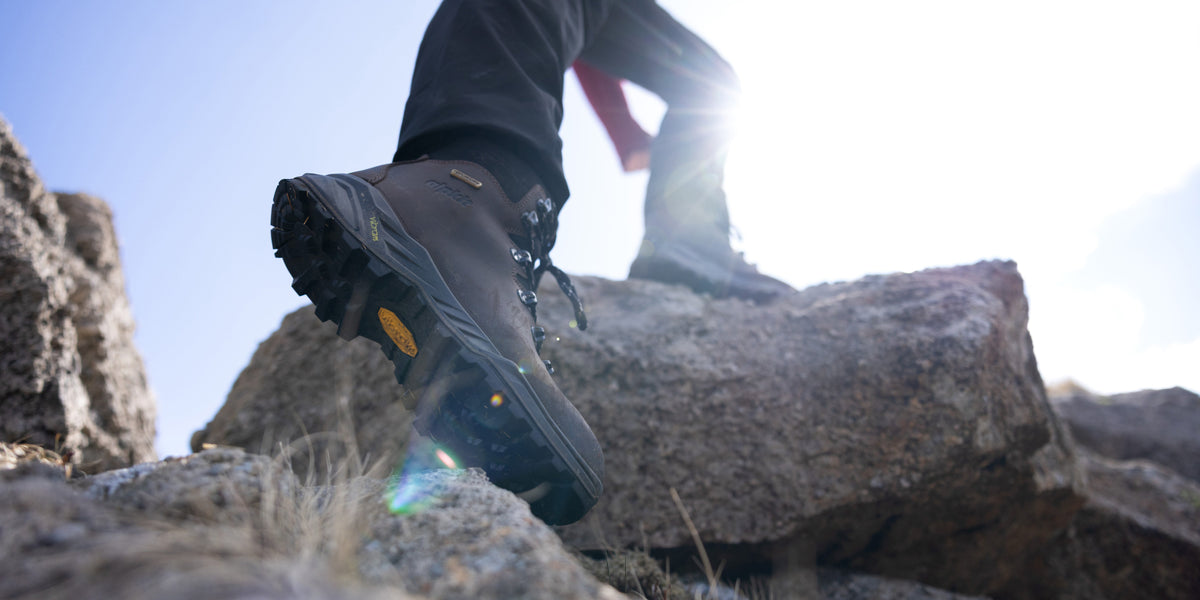


Choose for the roughest ground you walk on, then get the fit right. Boot or shoe, waterproof membranes, grip, B ratings and which of our seven suits you.
Choose walking boots for the roughest ground you'll walk on, then pick the pair that fits your foot best. Fit matters more than anything on the spec list. A boot that grips well but lets your heel lift will still give you blisters.
Our seven, by the walking each is built for:

In this guide
Walking footwear runs from light, flexible shoes to stiff winter boots. Each step up adds support, protection and stiffness, and each adds weight. The best choice is the lightest pair that handles the hardest ground on your usual walks.
Walking shoes are low cut and flexible, for good paths, summer hills and fast days with a light pack. Approach shoes are walking shoes with stickier rubber and a protective toe, made for scrambling and rocky walk-ins to the crag.
Three-season walking boots cover most UK hillwalking. They're mid cut and waterproof, with enough support for rough ground and a loaded pack. Technical mountain boots are stiffer again, for rocky alpine ground and scrambles. The stiffest take crampons for winter routes.
If you're buying for an expedition, choosing walking boots for the Duke of Edinburgh Award covers what each level asks for. To see our whole range side by side, read the Magnificent Seven.

A shoe is lighter and cooler. A boot gives more support and protection on rough ground and under a heavy pack.
Cut height is where the collar sits. A low cut sits below the ankle bone and leaves your ankle free to move. A mid cut sits at or just above it, and most walking boots are mid cut. A high cut sits higher still, for heavy loads and rough ground.
A higher collar keeps out stones and adds some stability under a heavy pack. It won't make up for a poor fit, though: if your heel lifts or your foot slides about, more collar won't fix it.
Weight counts for more on your feet than on your back, because you lift your feet with every step. If you've had ankle injuries, or you're carrying a multi-day pack over bog and rough ground, a boot is worth the extra weight. Hiking shoes vs walking boots goes through when each one wins.
In our range, Latitude is the waterproof walking shoe for fast summer days. Atlas is the boot for long days with a loaded pack, with a mid-height cuff for stability on uneven ground.

A waterproof walking boot has a membrane, a thin waterproof layer, between the outer and the lining. It stops water getting in from outside and lets water vapour from your sweat get out. For year-round UK walking, with wet grass, bog and rain, a waterproof boot is the sensible choice.
Membranes work in one of two ways. A microporous membrane, such as Gore-Tex, has pores too small for water droplets but big enough for vapour to pass through. A hydrophilic membrane has no pores. Water vapour is absorbed into it and passes through the material itself. All our waterproof boots and shoes use hydrophilic membranes, which keep moving moisture out even when it stays wet all day.
Montee and Latitude use Sympatex. Atlas, Pilot, Alta Rocca and Tierra use Tepor. Both are PFAS-free. Gore-Tex vs Sympatex explains how the two kinds compare.
A membrane has limits. Once water comes over the top of the boot, in a deep bog or a stream crossing, it keeps that water in too. And on a hot day any waterproof boot runs warmer than one without a membrane. For dry summer walking, a shoe without a membrane is cooler and dries faster. El Chorro, our approach shoe, has no membrane.

The sole decides how well a boot grips, how much it cushions you and how stiff it feels. Three parts matter.
Outsole. This is the rubber in contact with the ground. Deep, widely spaced lugs bite into mud and shed it, while shallower lugs suit hard paths. Softer, stickier rubber grips wet rock better, and harder rubber lasts longer. Montee, Alta Rocca and Pilot use Vibram XS Trek, a compound made for grip on wet rock and rough ground. Our other four use REACT soles: Grip on Atlas and El Chorro, Hike on Latitude and Trail on Tierra.
Midsole. This is the cushioning layer. Atlas, Pilot, Latitude, Tierra and El Chorro have PU midsoles, which are denser than EVA foam and generally hold their shape over more miles.
Stiffness. A shank or plate inside the sole makes it stiffer. A stiff sole spreads the load on rocky ground and gives a firm platform for edging and crampons, while a flexible sole is more comfortable on easy paths. Some boots add a rock plate, a thin layer under the foot that stops sharp stones pressing through. Montee has an ABS insert for stiffness, and Alta Rocca has a supportive platform for edging with enough flex for long approaches.
How a walking boot is built covers lasts, shanks, rands and the rest of the construction.

A B rating tells you how stiff a boot is and which crampons it takes. A crampon that doesn't match the boot can come off under load.
Montee is our B2 boot. A TPU heel welt built into the sole takes C2 crampons with rear clips. Always test your crampons on your boots before you head out. None of our other boots are made for crampons. For gaiters that stand up to stray crampon points, Matka has Kevlar-reinforced insteps.
B1 vs B2 mountaineering boots explains which rating suits which winter routes.

Leather is tough, resists scuffs and moulds to your foot over time. It needs cleaning and conditioning, and it's generally heavier. Synthetic fabric uppers are lighter, need little breaking in and dry faster, but tend to wear sooner on rocky ground.
When a boot has a waterproof membrane, the membrane keeps your feet dry, so choose the upper for toughness, weight and feel. Pilot has a 2mm oiled nubuck leather upper for a classic boot that ages well. Atlas has a 1.6mm split leather upper and Alta Rocca a 1.8mm split suede upper. Latitude, Tierra and El Chorro have split leather uppers. Leather vs synthetic walking boots compares the two in more detail, and the classic leather boot is the story behind Pilot.
A boot that fits holds your heel still, sits snug through the middle of your foot and leaves room for your toes.
Try boots on in the afternoon, when your feet are at their largest, and in the socks you'll walk in. Walk up and down a slope if you can. If your feet are wide, look for a wider boot rather than a bigger size, because going up a size adds length, not width.
Insoles can fine-tune a boot that's nearly right. A Sidas 3Feet Activ insole stabilises your foot and spreads pressure. A Sidas Outdoor Volume Reducer takes up space in a boot that's a little roomy, and a Sidas Heel Lift can take pressure off your toes. Insoles for walking boots explains which to use when.
In our stores, staff can measure both feet and work through the range with you. If you're buying online, measure your feet first, then use understanding walking boot fit for the checks to do at home. All our footwear comes with a 28-day Comfort Guarantee, so you can return a pair that isn't right for you. Socks change the fit too: see hillwalking socks.

Most modern boots feel comfortable from the first wear, but give them a few short walks before a big day. Wear them around the house, then on local walks, so any hot spots show up close to home. Leather takes longer to soften than fabric. How new walking boots settle in has more.
After a muddy walk, brush off the dirt, rinse the boots and let them dry at room temperature. Keep them away from radiators and fires, which can crack leather and weaken the glue. Re-treat leather when water stops beading on it. How to care for leather and fabric walking boots goes through cleaning, drying and reproofing.
We make seven, developed with bootmakers in north-east Italy (made where the great mountain boots are made). Each comes in men's and women's versions.
Atlas: for long trails and multi-day trips. A waterproof walking boot with a Tepor membrane, a supportive mid-height cuff and a PU midsole that cushions long days with a loaded pack. Men's Atlas and women's.
Pilot: for year-round British hills in a classic leather boot. A 2mm oiled nubuck leather upper, a Tepor membrane and a Vibram XS Trek sole, with a padded collar and tongue that are comfortable from the first walk. Men's Pilot and women's.
Alta Rocca: for scrambles, via ferrata and rocky alpine routes. A Vibram XS Trek sole and a supportive platform for edging on small holds, 9-point lacing to fine-tune the fit, and a full rand against rock scrapes. It has enough flex for long approaches, but it isn't a crampon boot. Men's Alta Rocca and women's. The detail is in Alta Rocca: built for the sharp end.
Montee: for winter walking and mountaineering with crampons. Our B2 boot, with a heel welt for C2 crampons, a Sympatex lining, a Vibram XS Trek sole and a reinforced rand against rock, ice and crampon scrapes. Men's Montee and women's.
Latitude: for fast summer hill days in a shoe. A waterproof walking shoe with a Sympatex lining, a split leather upper and a REACT Hike sole. It's lighter than a boot, with more support than a trail shoe. Men's Latitude and women's.
El Chorro: for scrambling and rocky walk-ins. An approach shoe with sticky REACT Grip rubber, a reinforced toe rand and 8-point lacing for precise footwork on rock. It has no membrane, so it's best on dry days. Men's El Chorro and women's.
Tierra: for days that mix walking and riding. A waterproof multi-activity shoe with a Tepor membrane, a REACT Trail sole that's stable on the pedals and protection at the toe and heel. For bikepacking with hike-a-bike sections, or a coast path with café stops. Men's Tierra and women's.

| Type | Best for | Membrane | Sole | Weight (UK 8) | |
|---|---|---|---|---|---|
| Atlas | Walking boot | Long trails, multi-day trips | Tepor | REACT Grip | 515g |
| Pilot | Leather walking boot | Year-round British hills | Tepor | Vibram XS Trek | 563g |
| Alta Rocca | Technical mountain boot | Scrambles, via ferrata, rocky alpine routes | Tepor | Vibram XS Trek | 537g |
| Montee | B2 mountaineering boot | Winter walking with crampons | Sympatex | Vibram XS Trek | 771g |
| Latitude | Walking shoe | Fast summer hill days | Sympatex | REACT Hike | 452g |
| El Chorro | Approach shoe | Scrambling, rocky walk-ins | None | REACT Grip | 408g |
| Tierra | Multi-activity shoe | Walking and riding | Tepor | REACT Trail | 565g |

See all men's walking boots and shoes and women's walking boots and shoes.
New


Sale


Sale


Sale


Sale


Sale


Sale


Sale


Sale


Sale


Sale


Sale


Sale


Sale


Sale


Sale