





Guide to choosing a bivvy bag
This guide covers bivvy bags for sleeping outdoors: wild camping, backpacking and mountaineering. If you are looking for a fishing bivvy, that is a different product entirely, a dome shelter used on the bank. This is about the sleeping shelters designed for use in the mountains.
The bivvy bag market for outdoor sleeping splits into two types. Most of the time, the right choice becomes clear once you understand the difference.
Hooped vs non-hooped bivvy bags
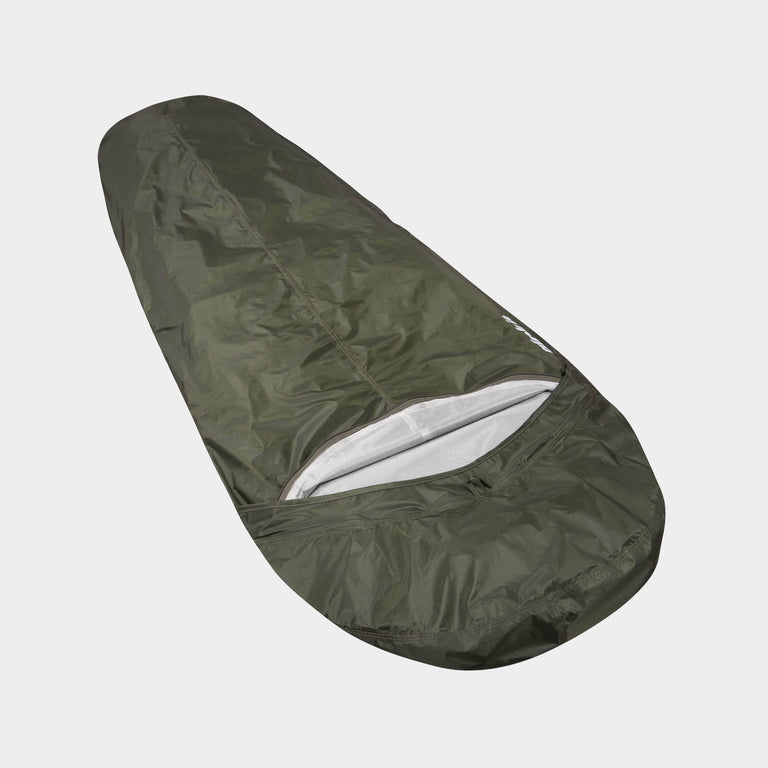
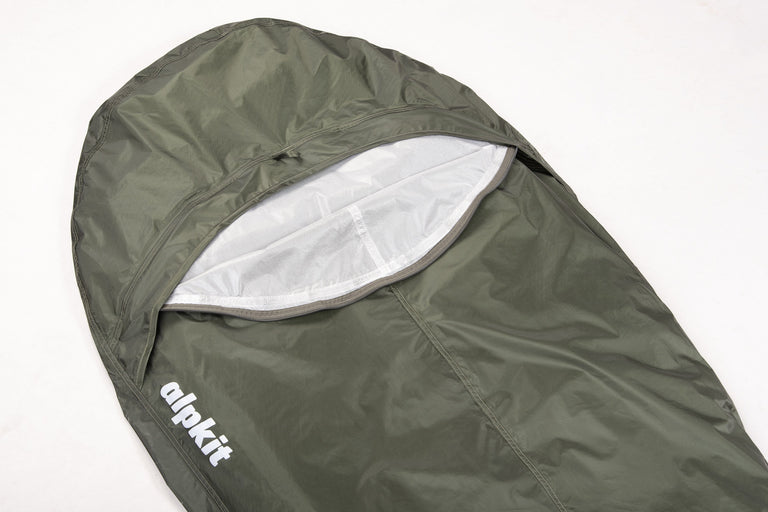
A non-hooped bivvy lies flat against your sleeping bag. You zip in, the fabric forms around you. No internal structure, no air gap. It is the minimal option: lighter, more packable, lower profile.
A hooped bivvy has a pole at the head end. This creates space above your face: condensation drops away from you instead of soaking back through, you can read without fabric against your nose, and you can sit up if the weather closes in. Protection is closer to a one-man tent, weight and pack size are closer to a bivvy.
Fast and light, counting grams, want the stars overhead: choose non-hooped. Extended nights out in bad weather, multi-day mountain trips, or you want headroom: choose hooped.
What to look for in a non-hooped bivvy
Four specifications determine how a non-hooped bivvy performs: weight, waterproof rating, breathability and size. Here is what each one means in practice.
Weight
The lightest non-hooped bivvies weigh around 200g. At that end, every gram saved carries a cost premium. A practical range for most backpackers is 280–350g: light enough not to notice in a pack, robust enough for hard seasons of use.
Waterproof rating
Look for a hydrostatic head (HH) rating of at least 10,000mm. That is well above the 1,500mm minimum to qualify as waterproof. For sustained rain, alpine conditions or winter use, 20,000mm gives meaningful headroom. You will feel the difference on a wet night.
Breathability (MVTR)
Breathability matters as much as waterproofing. A low-MVTR shell traps body moisture inside, soaking you from within. A high-MVTR shell allows that moisture to escape. The measure is MVTR (moisture vapour transmission rate): 10,000 is adequate, 30,000 is high-performance. In a bivvy, where the fabric is close to your face all night, you feel this difference clearly.
Size
Standard bivvies suit most users to around 185cm. If you are taller, broader, or want to pull your pack partly inside with you, look at the length and opening dimensions rather than just the pack weight.
The Alpkit bivvy range
Four models covering non-hooped standard, non-hooped ultralight, non-hooped XL and hooped. Each one is made with PFAS-free DWR and covered by the Alpine Bond guarantee.
Hunka: the starting point
330g. 10,000mm HH. 10,000 MVTR. Ripstop nylon. The Hunka is where most people begin with bivvying, and where many stop, it is straightforward, tough and proven across years of mountain nights. Not the lightest option, not the most technical, but reliable in every condition you are likely to face. All Alpkit bivvy bags are covered by the Alpine Bond guarantee.
Hunka XL: for bigger frames
The same construction as the Hunka, 20cm longer at 235cm and wider across the shoulders. Choose this if you are over 185cm, broader in the chest, or want extra room to pull a dry bag or footwear inside with you on a cold night.
Kloke: ultralight performance
285g. 20,000mm HH. 30,000 MVTR. PFAS-free DWR. The Kloke is for when weight and performance both matter. The waterproof rating is double the Hunka. The breathability is triple.
At this performance level, the two most directly comparable non-hooped bivvies on the UK market are the Terra Nova Moonlite and the RAB Alpine Bivi:
| Kloke | Terra Nova Moonlite | RAB Alpine Bivi | |
|---|---|---|---|
| Weight | 285g | 236g | 440g |
| Waterproof (HH) | 20,000mm | 10,000mm | 15,000mm |
| Breathability (MVTR) | 30,000 | 15,000 | 20,000 |
| PFAS-free | Yes | No | Yes |
| Price | £159.99 | £215 | £300 |
The table shows what direct-sale pricing means in practice. The RAB Alpine Bivi (£300) is 155g heavier than the Kloke, with lower waterproofing and breathability on every measure. The Terra Nova Moonlite is 49g lighter than the Kloke but has half the waterproof rating, half the breathability, no PFAS-free treatment, and costs a wedge more. Retailers typically add 40 to 50 percent on top of what a brand charges them. Alpkit sells direct.
If you are covering big mountain miles and sleeping out regularly, the Kloke is the one to choose.
Elan: when you want more than a bivvy
900g. Hooped. The Elan gives you weather protection closer to a backpacking tent in a package that packs smaller than one. The pole creates an air gap at the head end: less condensation, room to sit up, space to wait out a storm without feeling buried.
Comparable hooped bivvies from other brands, the OR Helium UL, the Lightwave Stormchaser, the Terra Nova Jupiter Lite, the RAB Ridge Raider retail for £240 to £420. The Elan at £109.99 offers the same hooped construction and weather protection for considerably less, for the same reason as the Kloke: direct sale, no retail margin.
If you are spending multiple nights in exposed conditions and want the option to sit out a storm, the Elan is the choice between the bivvy world and the tent world.
What reviewers say
The Hunka and Hunka XL regularly appear in independent "best bivvy bag" roundups, consistently rated as the standout value option in tests against products costing two to three times the price.
The Elan has two independent reviews published: Advntr's review of the Elan hooped bivvy and an assessment of the Elan as a lightweight hooped bivvy tent alternative.
Bivvy bag vs tent: when each makes sense
A bivvy suits solo fast-and-light travel where weight drives every decision, and nights where you want nothing between you and the sky. A tent suits partners sleeping together, cooking inside in bad weather, and trips where an enclosed space matters. If you're weighing up wider camping options, our camping guides walk through tents, sleeping bags and mats too.
Most people who bivvy regularly also own a tent. The two serve different trips. The question is which one this trip calls for.
If you are still deciding whether bivvying is right for you, the complete guide to bivvy bag camping covers conditions, setup and what to pack. For specific questions about using a bivvy in the rain or managing condensation, see our bivvying FAQs.